

Freckle Fifteen.
Is it the Effort the Counts?


Whenever I host something – dinner, drinks, a balcony get together, or even just a casual Wii and hang – I suddenly become extremely concerned with details. I’ll wander around a grocery store debating snack options as if the fate of the plans rests on the variety of crunches and chews. I always have a jar of candies on my coffee table, you know, for welcoming purposes. I’ll clean my apartment like my mom is coming over. I’ll light candles and turn on my candle warmer. I love a scent. Fold the blankets, fluff the pillows. Make sure the playlist is somehow both interesting and universally agreeable. And then, after everyone arrives, I pretend none of it required any thought or effort at all. Au naturel.
It’s a strange performance really. One where the effort must exist, but the evidence of effort must disappear. Part of this is simply my Type A personality. I love an itinerary. I like knowing what the plan is. I enjoy organizing things, coordinating logistics, and getting tasks done way too quickly. Planning and hosting come naturally to me.
But if I’m honest, some of that effort comes from a more anxious and insecure place. In a way, hosting becomes less about the event itself and more about managing how I will be perceived within it.
A constant worry that if the snacks are wrong, the vibe is off, or the apartment isn’t clean enough, people might not like me. Effort functions as a sort of social insurance.
That feeling – of constantly managing perception – is something I’ve been trying to better understand. Recently, I was listening to an episode of Oprah’s Super Soul podcast with therapist and bestselling author, Dr. Shefali discussing her book A Radical Awakening. I’m not necessarily seeking out these self-help things, but my therapist recommended it to me. Anyway, one theme in particular resonated: “The real indicator of power has nothing to do with how you exhibit yourself. The true metric of power is your inner worthiness.” In other words, the most powerful and at peace people are not constantly managing how they are perceived.
Yet most of us are trained to do exactly that. We are taught to crave approval, validation, praise. We women, especially as the stereotypical homemakers and hosts, internalize the idea that how others experience us is the ultimate measure of our value. We’re expected to host beautifully but not seem anxious about it. To look beautiful but not appear vain or overly done. To be kind but not desperate for approval. To succeed professionally but not seem overly ambitious and bossy. Care, but definitely don’t care too much. And finally, put in effort, but make sure no one can see it. It’s an impossible balancing act that continues to be explored in books, movies, art, and the human mind. Effort is required, but visible effort is punished.
Nowhere is this contradiction more obvious than in how we talk about effort. Trying too hard is one of the worst social accusations you can receive. “Try-hard” in gym class was the ultimate insult. I razzed (bring back razz) my co-worker Liz for taking out her umbrella in a New York City drizzle. Classic try-hard move. All the while, the act of trying is literally how success and safety occur. Culturally, we admire people who appear to somehow succeed without trying at all.
And yet, effort is also one of the most common ways we show love. Think: planning trips, remembering important days, cooking meals, sending the “Did you make it home safe?” text. Cough, acts of service, cough. So, for some people, effort reads as care. For others, it reads as pressure. Or, a humiliation ritual. Which makes me wonder if the real question isn’t whether effort counts. But rather, how and why we evaluate it in the first place. Take a shot every time I say effort.

The eff…ortlessness that we know and admire is not an absence of eff…ort. Instead, it is an aesthetic.
Fashion has long operated as one of the clearest sites where this illusion is constructed and maintained. What we call “style” is often less about what is worn and more about how much labor appears to have gone into wearing it. This is a form of cultural conditioning.
Watching In Vogue: The 90s, shaped under the editorial authority of Dame Anna Wintour, you begin to see how deliberately this ideal was constructed. Fashion in that era did not simply move away from excess; it reframed effort itself. As the previous editor-in-chief of British Vogue Edward Enninful noted, “Anti-fashion became fashion.” The rejection of obvious styling became a style in its own right.
No figure embodies this shift more clearly than Kate Moss. Her emergence in the 90s marked a departure from the polished, overtly glamorous supermodel toward something far more ambiguous. The aesthetic was undone, slightly disheveled, and almost indifferent. Shirts draping off of shoulders, messy hair, pale skin, a smudged lip. Or no lip color at all (#heroinchic). Maybe some torn up jeans. Regardless, the (favored skinny) body preceded the clothing. Effort, if present, was concealed beneath the appearance of natural instinct. But what appears instinctual can be (and at the time, was often) highly constructed.
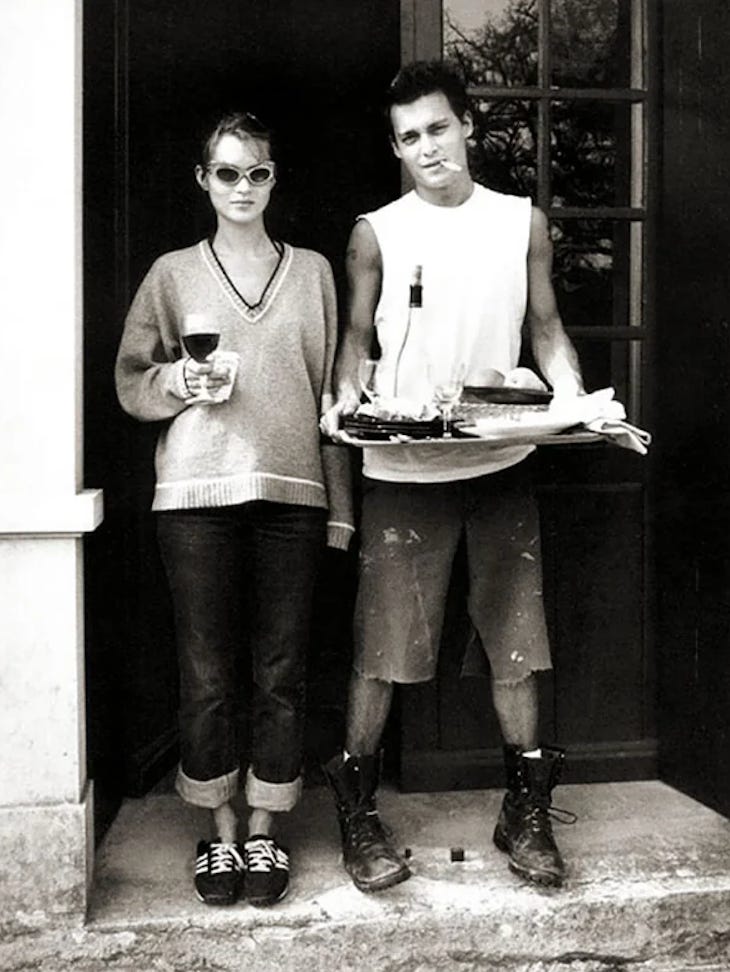
Kate Moss & Johnny Depp
During the 90s, even red carpets – once defined by overt opulence and drama – began to encourage this “anti-fashion.” The grunge movement and its anti-establishment ethos seeped into high fashion, blurring the line between “dressed up” and “dressed down.” Over time, obvious glamour began to feel almost unsophisticated and gaudy. And, as with all aesthetics, we watch the cycle, well cycle.
After a brief stint of grunge, glamour returned. Then left again. Then they both coexisted. And now, glamour is admired again, but carefully. It is no longer about maximalism for its own sake, but about what could be called effortless glamour.
Effortlessness, in this sense, operates as a form of cultural capital. To look effortlessly beautiful is to signal that you possess the resources – genetic, economic, aesthetic – that make visible effort unnecessary. It implies taste without formal education, beauty without intervention, and composure without the need for discipline. In reality, it is not the absence of labor but its successful disguise. Effortlessness, in turn, is an elite effort.
The mysterious minimalism associated with Carolyn Bessette Kennedy, the calibrated simplicity of Calvin Klein and KHAITE, the undone aesthetic of R13, and the barely-there precision of Nina Park’s makeup looks all rely on the same premise: the ideal presentation is one that does not appear labored. Even when executed flawlessly on figures like Emma Stone at the 2026 Oscars, the success of the look depends on its ability to obscure the process behind it. She just woke up like this, you know?
What is particularly striking is how quickly aesthetic judgments become moral ones. As we know, appearance is rarely interpreted as neutral; it is read as evidence of character. Natural makeup is understood as authenticity, while heavier application risks being coded as insecurity or excess. So, that’s probably why guys hate birthday makeup. Vintage clothing is interpreted as tasteful, while logomania designer can be dismissed as trying too hard. In this way, effort is not only evaluated but also used as a measure of your morals.
The governing rule becomes clear: the most socially rewarded form of effort is the kind that appears accidental. Contemporary aesthetics such as the “clean girl,” “no makeup makeup,” or “model off-duty” look all depend on this paradox. Each requires a significant degree of maintenance, discipline, and intentionality; yet, their success hinges on the illusion that none of this exists in the first place. And as in hosting, as in relationships, as in nearly every other domain, the contradiction remains intact: effort is necessary, but its obviousness is a sort of liability.
To be effortless, then, is not to abstain from effort, but to render it invisible.

There is, however, a specific kind of effort that rarely gets labeled as trying too hard.
I thought about this while watching my sister – yes, the Elizabeth Parker Eats herself – cook and prepare food for our cousins after they had their first baby in February. It wasn’t framed as excessive or attention-seeking. No one was like, “Wow, she’s doing the most.” And that’s what’s interesting. The effort was still there – time, planning, execution – but it didn’t carry any of the social risk that “too much” effort usually does. Which makes you realize that not all effort is created, or rather perceived, equally.
And yet, outside of these interpersonal dynamics, there are entire systems of contribution that operate on a different set of expectations altogether. Think about the kinds of people whose work is built around giving rather than being seen: overworked parents organizing local efforts, teachers staying after class to help a struggling student, social workers tending to others’ needs, and baby nurses watching a newborn overnight so the mom can get some rest. Their efforts are not performative for social approval but because the work itself requires it.
There’s no expectation tied to this work that it should appear effortless. In fact, the effort is often understood to be exactly what makes it meaningful. And unlike the kind of effort that gets judged in social settings, this form of giving is rarely dismissed as excessive or performative.
Care, in these contexts, is one of the few spaces where effort is still supposed to be visible. And still, even here, there’s an asymmetry. Much of this labor is essential, yet underappreciated. And yet, we still want our effort to be acknowledged.
There is a reason Monica Geller is both beloved and slightly exhausting. She is the perfect host; the one who remembers, prepares, and anticipates everything. The apartment is clean, the food is ready, and all the details are handled. But beneath all of that is a very real desire for acknowledgment and praise. A need for someone to say: this didn’t just happen. You did this.
Still, there’s a mental negotiation happening. How much of that effort should remain invisible? And at what point does invisibility start to feel like erasure? Because even when the effort is generous, it is still effort. It still takes time, attention, and energy. And so perhaps you oscillate between wanting to give freely and wanting, at the very least, to be recognized for giving at all. Because giving, in any form, still takes effort.
Since I, too, am so giving, please see a recipe for Elizabeth’s Miso Cod and Cucumber Salad, a favorite dish that she dropped off to our cousins.
Miso Cod
Ingredients:
2 pieces of cod (3 to 4oz)
3 tbsp Miso Paste
2 tbsp mirin (Japanese cooking wine)
2 tbsp sake (can omit if you do not have)
1.5 tbsp white sugar
¼ cup water
Directions:
Preheat oven to 350°F.
Mix together miso paste, mirin, sake, white sugar and water until miso and sugar have dissolved. Add miso mixture to a plastic bag, place cod fillets inside bag with miso mixture and let marinate for at least 30 min. (Can also sit overnight if preparing ahead of time.)
Line a baking sheet with tinfoil and a light drizzle of olive oil. Remove cod fillets from the marinade and place onto prepared baking sheet.
Bake in oven for 15-20 minutes. Remove from oven and serve with cucumber salad and rice.
Enjoy
Cucumber Salad
Ingredients:
1 English Cucumber
¼ cup Rice Wine Vinegar
1 tbsp sugar
1 tbsp salt
Sesame seeds to garnish
Directions:
Thinly slice cucumber and put into a bowl, or container with a lid.
Add in rice wine vinegar, sugar, and salt.
Mix together (if using a bowl) or shake together (if in a container with lid) until combined. (Optional to add additional sugar or salt to taste preference).
Top with sesame seeds.
Enjoy
She also makes unreal brown butter chocolate chip cookies. Obviously. Order link here.
As we discuss a form of giving, please find two-bites or the top two places I recommend this month described in two adjectives (bites):
Gargiulo’s - timeless & rich
Skinny Louie - unfussy & retro

Blah Blah Blah. You’re not going to read anything until I talk about Carolyn Bessette Kennedy and JFK Jr. I know my audience. Fine.
If effort, in its most legible form, is about doing, then according to Newton’s Third Law (I say as I push my glasses up the bridge of my nose with one finger), there is a counterpart that operates through restraint. Not the absence of effort, but its strategic concealment. A withholding of visibility that, paradoxically, reads as ease. We’ve talked about this with Kate Moss, but this mystery is part of what sustains the current obsession with their relationship, especially with the resurgence of Love Story.
Their dynamic is remembered as a kind of aesthetic ideal: minimal, simple, seemingly untouched by the excesses of public life. But what made the show so compelling was not just the romance itself, but the conditions under which it existed: a constant negotiation between intimacy and exposure. Privacy, in this case, was not passive. It required maintenance, boundary-setting, and, as the show makes clear, very real measures to keep certain aspects of their lives out of view (Esquire).
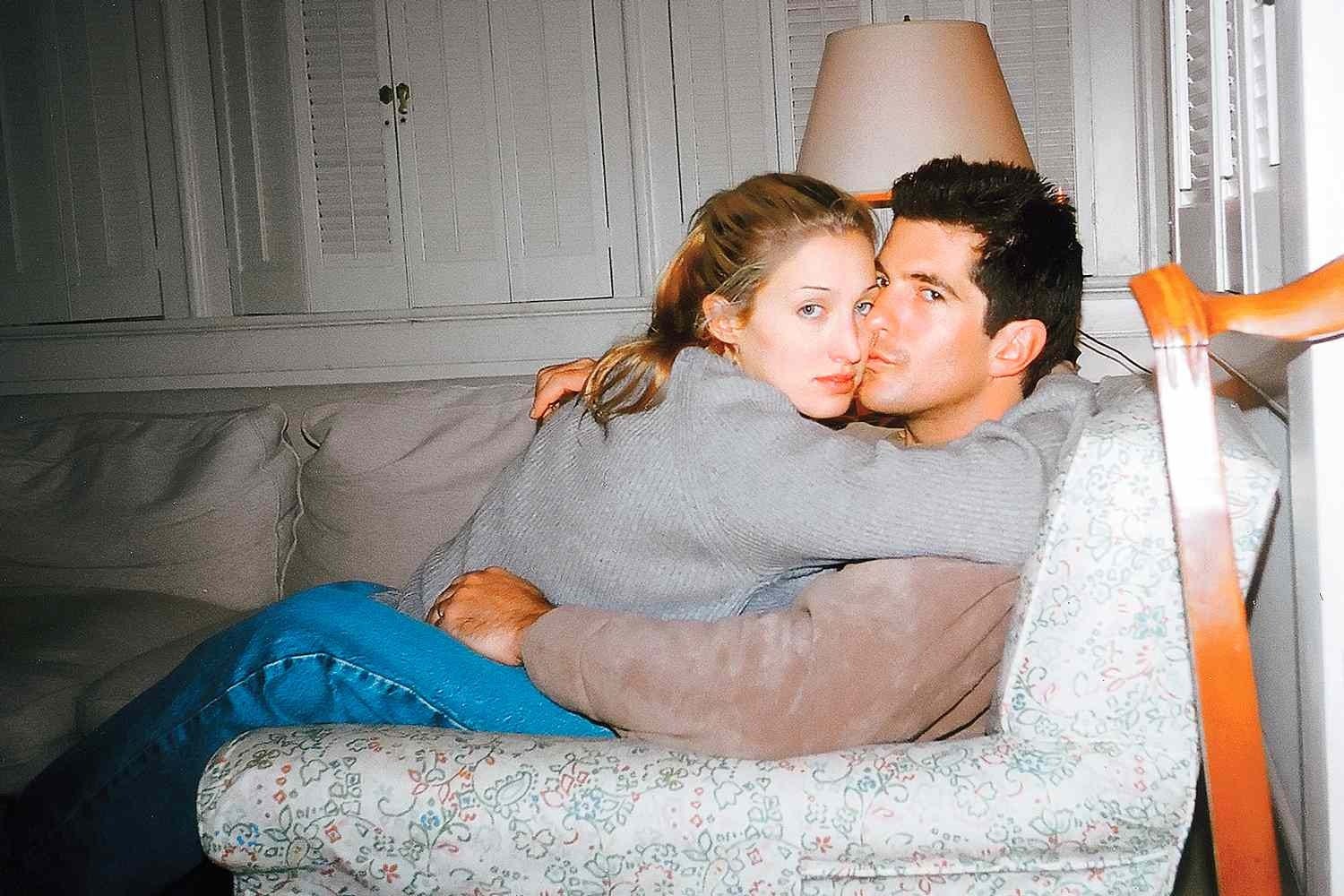
Carolyn Bessette Kennedy & John F. Kennedy Jr.
And yet, Bessette in particular is remembered for her effortlessness. Her style, her demeanor, and her near-refusal to engage in all of it gets labeled as something “natural.” But that reading ignores the structures underneath. The minimalism, the discipline, and the consistency; this is not the absence of effort (I mean, we know she worked for it), but its refinement. And, limited access.
A similar dynamic shows up now in figures like Dakota Johnson. Positioned as the modern Calvin Klein girl, she embodies a very specific aesthetic: precisely undone. The effect is casual, cool, unbothered. But nothing about it is accidental. What presents as unintentional is, almost certainly, highly mediated.
Calvin Klein selecting Johnson for the brand solidifies that character we already perceive.
Culturally, we are instructed to assume this posture. “Don’t be a try-hard.” “Play it cool.” “Be a little mysterious”... they say. The implication is that visible effort diminishes value, particularly in romantic and social contexts. And yet, the very things that sustain relationships – attention, responsiveness, care – are forms of effort that cannot be entirely obscured without consequence. The performance of effortlessness begins to conflict with the reality of maintenance. (Sometimes I write sentences and reread them and I’m like… yes.)
It is perhaps the Italian novelist Elena Ferrante (pseudonym) who offers the most compelling departure from this. I read an interview between her and Sheila Heti in Brick Magazine, where Heti describes Ferrante as someone who has achieved “...the maintenance of total privacy as a human being, along with total openness as a creator.” Which today, frankly, feels impossible.
By refusing public visibility altogether, Ferrante removes the expectation of performance. There is no image to interpret, no persona to decode; but, only the work itself. In her writing, she distinguishes between truth and the effect of truth, suggesting that much of what we consume is shaped less by authenticity than by its simulation. In other words, we are often responding not to what is real, but to what has been made to feel real.
Her anonymity reframes the entire question. Rather than asking how to appear effortless, she sidesteps the need to appear at all. Which introduces a more difficult proposition: what if the most rigorous form of effort is not in perfecting the performance, but in declining to participate in the first place?
Because that kind of refusal is not neutral. It requires a tolerance for misinterpretation, for loneliness, for a lack of immediate validation. It asks you to relinquish control over how you are perceived.
And suddenly, all of this starts to converge…the effortlessness of Bessette, the planned authenticity of Johnson, the total withdrawal of Ferrante. These are all different strategies with the same underlying tension: can you control your perception?

I went home this past weekend (Chicago suburbs) which always feels a little fake to me because I don’t actually live there anymore, and I haven’t yet had a post-grad Chicago phase either. I went straight from the suburbs to the University of Michigan to living in New York City. So now when I go back, I feel as if I’m visiting my own life. Anyway.
If you are me, this is the perfect suburban weekend. Imagine it’s a nice, sunny day:
FRIDAY
NIGHT
You get into O’Hare International Airport and a family member picks you up (the ultimate sign of love). You also don’t have a checked bag, because that makes life more inefficient.
Once you get home, you immediately eat something you’ve been thinking about for weeks. Probably Barnaby’s pizza. Slightly cold and still perfect. Or, my mom’s brisket.
Then, you get ready to hang at your friend’s house. (Maybe?) Perhaps it’s Ari’s basement, Emily’s kitchen, Colin’s shed, or Naomi’s pool if it’s warm enough. Who knows? But, it lasts until around 1:30 am if we’re hanging out correctly. The boys will likely bike home.
Bed. Love bed.
SATURDAY
MORNING
You wake up and immediately need breakfast. If your Dad is out golfing or working (not home to cook you eggs), then these are the best places to go. FYI, I can cook eggs for myself, but when I’m home, I love princess treatment. Ok, not just when I’m home.
Hometown Coffee & Juice: if you want a breakfast sandwich, avocado toast, or to run into your best friend’s ex from middle school.
Walker Bros. The Original Pancake House: if you want to feel a sense of nostalgia and wait a long time for the perfect mini chocolate chip pancakes. There are, however, sticky children everywhere.
Once Upon a Bagel: if you miss New York but don’t want to admit it.
Then maybe, just maybe, you get an iced vanilla latte from Towne & Oak and pay for it later.
MIDDAY
Then you go for a run (walk) outside or maybe you do some yoga at Reach Yoga or CorePower Yoga. Perhaps you get a little mani-pedi at Oak Spa Nails. Or, you just sit at your kitchen counter again with your family.
Then, it’s time for lunch, when you should definitely get Max & Benny’s. It’s an incredible deli with classic soups, sandwiches, and that familial feel. I always get a Diet Dr. Brown’s black cherry soda.
If not Max & Benny’s, then:
Foodstuffs (my gourmet grocer before Butterfield Market)
Three Tarts Bakery & Cafe (so quaint, so cute. A lot of elders.)
Little Louie’s (Every Sunday, I went there for char dogs and cheese fries and to play on the claw machine that I never won. My sister also choked on a costume mustache and threw up all over the table here. Ahh, happy memories.)
Michael’s Grill & Salad Bar (for an alternate char dog and cheese fries experience or a caesar wrap on par with that of Lenwich)
Afterwards, you drive around Forestway Drive or Sheridan Road listening to old playlists.
Then you go to Glencoe Beach and look for sea glass. I used to do this with my mom growing up, and she has a bowl in our home filled with all the sea glass we’ve collected over the years.

Michael’s Grill & Salad Bar: A Spread
EVENING
Dinner is a mood situation:
More serious and fancy: Sophia Steak (...steakhouse), Le Colonial (French-Vietnamese), Guildhall (American), Pomeroy (French), or Indus (Indian)
Orrrr…. You could do dinner and drinks at Mino’s with some delicious pizza and spritzes.
If you stick to the separation of church (dinner) and state (drinks), then after dinner you can head to Fred’s Garage for cocktails and, yes, brews.
If you want to avoid drinking culture altogether, you can go to Homer’s or Graeter’s for ice cream. Ooooh, or Love’s Yogurt if you’re feeling that instead.
Yay, because bed.
SUNDAY
MORNING
Start your day with dread. Dread that you have to leave the peaceful suburban oasis and head back to the busy, smoke-ridden city :)
Then, suppress that dread with some baguettes and pastries from That Little French Guy. I’ll usually enjoy these with homemade coffee, sitting in the backyard with my mom, listening to the windchimes. Or on the couch if it’s too chilly, fake watching some professional sports game.
And, goodbye safe haven. Hello, TSA.
This truly has nothing to do with my overarching theme, but I hope you had fun. Wait actually, that whole itinerary took effort. Ayyy.

What does it mean to be difficult? How do we make ourselves easier? Why do we have to? Is it to avoid rejection? Why do we have to avoid rejection? Just a glimpse into my brain.
Women, in particular, are rewarded for being agreeable, pleasant, accommodating, emotionally laborious; the kind of person who keeps things running smoothly without drawing attention to the fact that anything is being managed at all. The ideal is not just to be kind, but to be kind in a way that feels effortless to others.
But that reward system has a flip side. The same behaviors that earn approval can also result in withdrawal the moment you introduce any friction or conflict. Anger, bluntness, ambition and inconvenience are often read not as natural human expressions, but as disruptions. And disruptions, in a system that values ease, tend to get labeled as “difficult.”
Not necessarily because they are unreasonable, but because they make something visible that people prefer to remain unspoken: the assumption that you will adapt yourself in order to remain in line with their expectations of what you should be.
So lately, I’ve been actively trying to be a little bit more difficult. Not in the throwing-my-drink kind of way or making everyone around me uncomfortable. But in the more inconvenient sense. The kind where I ask for what I deserve. Or, I say no without an elaborate excuse and explanation. I admit that something bothered me instead of immediately minimizing it to keep the peace. Because what often gets labeled as “difficult” is really just a refusal to fake ease at your own expense.
And, my mom wonders why I don’t have a boyfriend right now. I’m busy running social experiments. Okay?
It’s always about asking the follow-up question. It’s about choosing not to absorb the emotional labor in a group just because you’re the one most capable of doing it. It’s about letting there be a little bit of friction instead of immediately smoothing it over, so everyone else can remain comfortable. To be clear, none of that is particularly radical. It just feels that way because we’ve been trained to believe that the cost of being liked is being easygoing.
But being “easy” often requires a kind of self-abandonment. So when you choose not to do that – when you tell the stupid man off for screwing you over, when you actually do care what topping goes on the pizza, when you don’t hide your facial expressions – it reads as a shift. And, people notice shifts. Sometimes they call it confidence. Sometimes they call it growth. And sometimes, they call it difficult.
Which is interesting, because the behavior itself hasn’t necessarily changed. You’re still kind. You still care. You’re still thoughtful. You’re still you. You’re just no longer willing to contort yourself to make it easier for other people. And maybe that’s the point where the whole idea of effort starts to feel different.
Because just like hosting, just like style, just like relationships, and just like caregiving… There’s invisible labor happening here too: anticipating reactions and managing perceptions. There is an effort it takes to be liked.
So choosing not to give all your time to being liked, in a sense, is its own kind of effort. One that doesn’t necessarily look polished or seamless. One that might actually feel a little messy and cause a little drama. But maybe that’s the trade-off.
Because if effort that is visible gets labeled as “too much,” and effort that is invisible gets taken for granted, then being “difficult” might just be the moment where you stop trying to make your effort disappear altogether.
So maybe the question isn’t whether effort counts. But why certain forms of effort are allowed to count publicly, while others remain in the background, assumed and expected rather than acknowledged.
Because in hosting, in relationships, in the way we present ourselves, effort often has to be hidden in order to be accepted. Meanwhile, in other spaces – teaching, caregiving, volunteering – effort is both expected and invisible. Which makes “difficult” feel less like a fixed trait and more like a label that shifts depending on context. The same energy that is read as thoughtful in one setting can be read as excessive in another. The same attention to detail that is appreciated in a caregiver can feel overbearing in a social setting.
The difference isn’t always the effort itself, but how it is interpreted, and whether that interpretation serves the expectations of the space you’re in. And, always ask yourself the follow-up question: who am I putting in all this effort for?
Sorry, I ended on a preposition, and I’m also sorry that you’re likely blacked out from all the times I said “effort.”
Actually, I’m not sorry.
Julia
Barnabys…always first goldman stop from the airport! Takes effort, but always worthwhile :) Great piece and now I’m starving 💛
🩷♥️🧡